
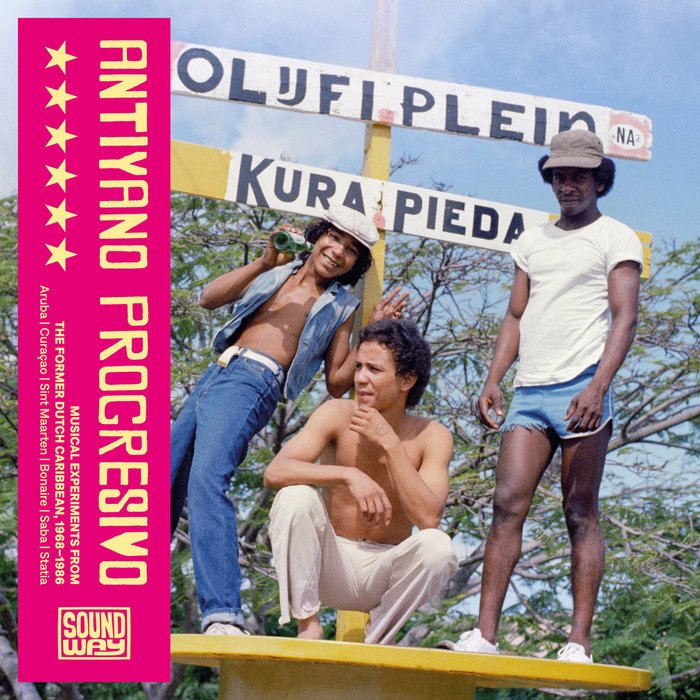
Sometimes a lost genre is not lost at all. It is sitting in somebody’s house, remembered by the people who lived it, waiting for the rest of the map to catch up.
The islands were already experimenting
Soundway’s Antiyano Progresivo: Musical Experiments from the Former Dutch Caribbean, 1968–1986 starts with an archival problem. Across Aruba, Curaçao and Sint Maarten, musicians were sharing stages, ideas and records while making work that crossed local forms with funk, soul, psychedelia, disco, Latin music and other sounds moving through the region. Many recordings were issued in small local runs. Some were barely archived. Wider histories of Caribbean music often passed them by. The compilation, released October 9 and assembled by Rozaly and Jumanne, does not “discover” that scene. That word would repeat the problem. The musicians and their audiences already knew the music existed. The project makes a regional memory newly accessible to people outside the communities that kept it.
PULL QUOTE: A canon is often just an archive with better marketing.
Stop treating experimentation like an import
Caribbean music is frequently organized for outsiders into a handful of export-friendly categories. That can make experimental work look like an exception—as though island musicians only became adventurous after encountering a supposedly more sophisticated outside culture. Antiyano Progresivo breaks that hierarchy. The music shows artists taking what moved through their islands and transforming it through local taste, politics, instruments, languages and social life. Cross-pollination is not evidence of a culture lacking its own identity. Port cities and islands are often sophisticated listening environments precisely because people, records and technologies move through them. The result is not “world music” in the vague record-store-bin sense. It is specific history.
Listen for the network
The compilation includes sixteen tracks. Rather than treating them as curiosities, listen for the network itself: musicians responding to each other across islands and eras, local forms meeting international ones, and tiny releases carrying ideas that were larger than their distribution. For a first pass, start with the tracks Soundway makes playable on the album page and then follow the credits outward. Read the liner notes. Notice who photographed the scene. Notice the designers. Notice the compilers. Archive work is collaborative work. That is another reason physical editions matter: a properly assembled reissue can restore context that a detached audio file cannot carry alone.
Thanksgiving for the people who kept the box
The November issue is about gratitude without sentimentality. This story offers the cleanest version of that idea. Somewhere, someone kept the record. Someone remembered the musician’s name. Someone knew which photograph belonged to which period. Someone answered a question from a compiler decades later. Cultural preservation is full of people whose names never appear on a chart. Thank them by crediting them. Thank them by buying the record from the people doing the restoration. Thank them by refusing to call the culture “forgotten” when what you really mean is that the mainstream archive failed to notice it.

 Los Angeles | Redlands | Phoenix | Memphis | NYC
Follow us: @GemworkTV | Contact: info@gemwork.tv
