
Streaming removed friction from listening. Vinyl turned friction into ritual. Hip-hop has always understood the difference because the turntable was never only a playback device. In the right hands, it became an instrument, an archive and a way of touching time.
Vinyl did not return to defeat streaming
The vinyl resurgence gets described like a revenge movie: analog comes back from the dead to defeat the apps. That is not what the numbers say. Streaming remains the dominant recorded-music format in the United States. But the RIAA’s 2025 year-end report shows vinyl continuing to occupy a meaningful physical-media lane: 46.8 million units shipped and roughly \$1.043 billion in wholesale revenue, both up from 2024. Vinyl does not have to beat streaming to matter. It solves a different problem. A stream is almost pure access. A record is access plus object, artwork, sequence, storage, maintenance, credits, ritual and inconvenience. That inconvenience slows the listener down enough to notice the album as a designed thing. Hip-hop understood that long before the current vinyl boom because the turntable had already escaped its original job description.
PULL QUOTE: Streaming erased friction. Vinyl turned friction into ritual.
The turntable became an instrument
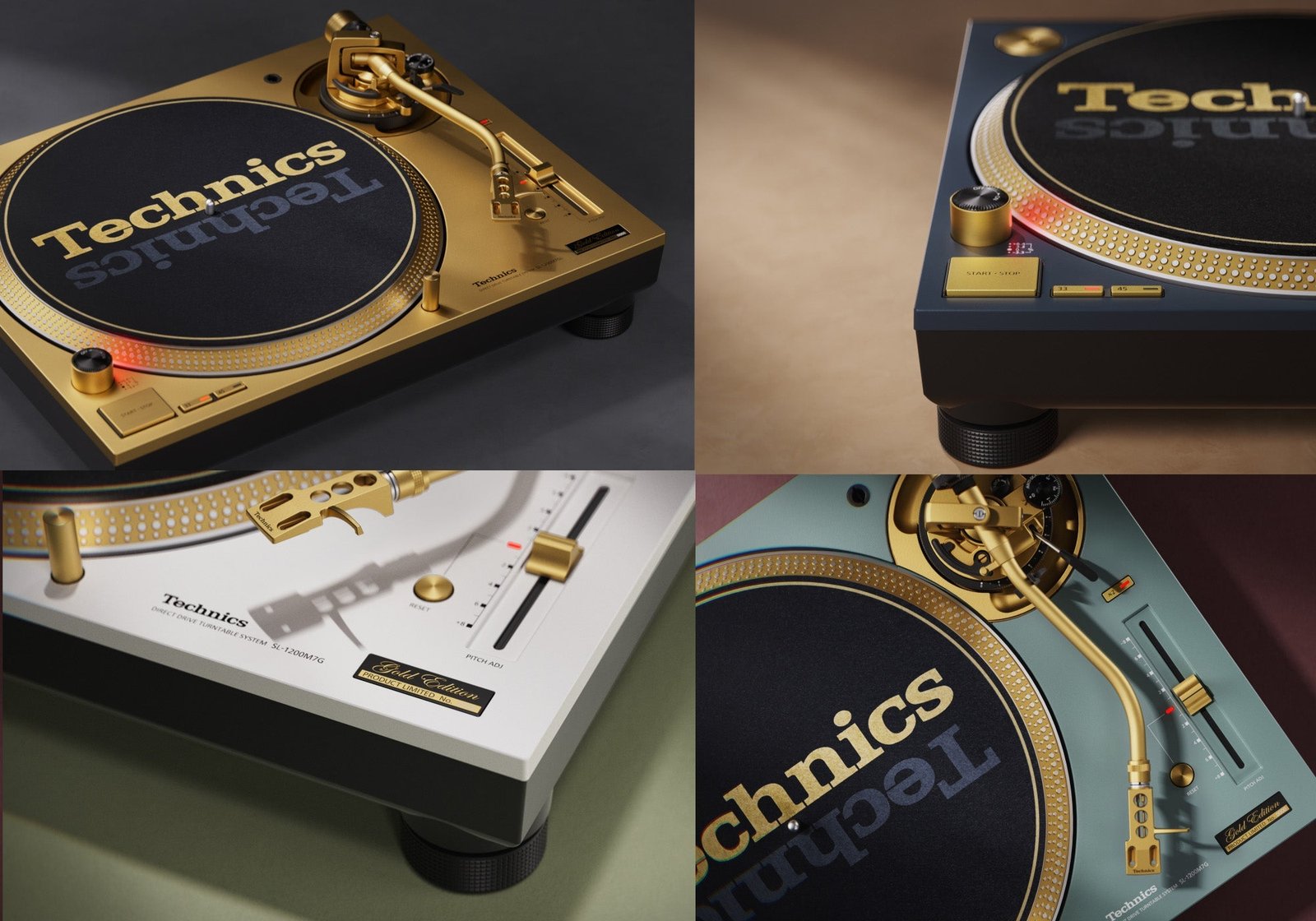
Technics’ SL-1200 lineage is inseparable from modern DJ culture because reliability, pitch control, cueing and direct drive made records manipulable in performance. In 2026, Technics marked 55 years of the series with the SL-1200M7G Anniversary Edition, a globally limited run of 12,000 units built on the MK7 platform. The anniversary model is intentionally visual—seven colorways, gold accents, serialized badge—but the cultural point is larger than decoration. Technics itself frames the SL-1200 as equipment that helped shape beatmatching, scratching and hands-on DJ performance. The object sits at the strange intersection of hi-fi, instrument and cultural tool.
Three 2026 decks worth watching
1. Technics SL-1200 55th Anniversary Edition
Announced in August for global September release, the anniversary edition uses the MK7’s coreless direct-drive platform, offers pitch adjustment up to ±16 percent, and adds reverse play, the familiar S-shaped tonearm and serialized gold-accent presentation. At \$1,599.99 on the U.S. product page, it is not an entry-level nostalgia piece. It is a collectible performance deck tied directly to DJ lineage. Best for: DJs, collectors and people for whom the SL-1200 story is part of the purchase.
2. Audio-Technica AT-LP7X
Audio-Technica released the AT-LP7X in January as a fully manual belt-drive deck aimed more at serious listening than turntablism. Its official manual specifies a 20 mm acrylic platter and a built-in phono stage that supports both moving-magnet and moving-coil cartridges. It uses a J-shaped tonearm and 33⅓/45 rpm playback. The interesting word here is manual. As convenience dominates consumer electronics, the LP7X asks the listener to remain physically involved.
3. Kanto Obi3 2nd Gen
Kanto’s September announcement positions the second-generation Obi3 as a more accessible manual deck with modern flexibility: weighted aluminum platter, sensor-controlled belt drive, adjustable counterweight and anti-skate, ±10 percent pitch control, built-in phono preamp and Bluetooth 5.3. That combination is telling. Vinyl’s new audience does not necessarily want to choose between tactile analog habits and contemporary convenience.
The record is also a receipt
For G.U.M.M., the vinyl story connects directly to this issue’s larger question about cultural memory. A physical record can hold credits, art, liner notes, catalog information and sequencing in a form that does not depend on an app continuing to license the album. It is not immortal, and it is not automatically ethical or archival simply because it is pressed to plastic. But it is another copy of the memory. That redundancy matters.
Give somebody the object
There is a Thanksgiving idea hiding in the crate. Give somebody a record that matters to you and explain why. Not because vinyl is superior. Because passing a physical object from one person to another changes the conversation. You have to choose it. Carry it. Hand it over. Maybe tell the story. Hip-hop culture was built through that kind of transfer long before recommendation engines learned how to imitate it.

 Los Angeles | Redlands | Phoenix | Memphis | NYC
Follow us: @GemworkTV | Contact: info@gemwork.tv
