# October 2026
- Link: https://gumm.digital/
- Published: 2026-09-30T21:02:46-07:00
- Author: NuCreative Media LLC
The Culture. The Music. The Movement.
[DNKYBongsTV Network](https://dnkybongstv.com/) [Back Issues](https://gumm.digital/issue/)
[Submit Music](https://gumm.digital/submit-music/) [Shop](https://gumm.digital/shop/)
[Join Us](https://gumm.digital/membership-join/)
October 2026Interactive Issue
[G.**U**.M.M.](https://gumm.digital/)
Gemwork Urban
Music Magazine
[The Issue](https://gumm.digital/#gh-issue) [Latest](https://gumm.digital/#gh-latest)
[Gemwork TV](https://gumm.digital/#gh-tv) [Music](https://gumm.digital/#gh-music)
[Gemwork Radio](https://gumm.digital/#gh-radio) [Business](https://gumm.digital/#gh-biz)
[World Eclectic](https://gumm.digital/#gh-world) [Culture](https://gumm.digital/#gh-culture)
[Archive](https://gumm.digital/#gh-archive)
[ ⌊G.U.M.M. October 2026 cover, Blueprint Sankofa: What we inherit. What we transform. What we pass on.⌉ ](https://gumm.digital/2026/09/30/blueprint-sankofa/)
Cover Story · Blueprint Sankofa · Series I
# Blueprint _Sankofa_
What we inherit. What we transform. What we pass on.
Music · People · Culture · Legacy
[Read the Cover Story](https://gumm.digital/2026/09/30/blueprint-sankofa/) [Every Story](https://gumm.digital/series-category/gemwork-urban-music-magazine/)
[ ⌊Archival photograph of George E. Lee’s Singing Novelty Orchestra gathered around
a piano and drums.⌉ Cover Story · 03
### Sam Jr.
Where the music turned visible.
[ ⌊Portrait of Pastor Clinton Utterbach, from the family archive.⌉ Cover Story ·
04
### Soul Goes to College
Clinton carried it forward.
[ ⌊Cynthia Utterbach, jazz vocalist, portrait.⌉ Cover Story · 05
### Cynthia Onstage
Discipline in plain sight.
## The Latest
[All G.U.M.M. stories](https://gumm.digital/series-category/gemwork-urban-music-magazine/)
Watch
## Gemwork TV
[Watch & Listen](https://gumm.digital/watch-listen-2/)
[ ⌊DNKYBongsTV main hero banner.⌉ DNKYBongsTV Network
### Every show on the network in one place
Live radio, original programming and long-form conversation. Pick a room and press
play.
Continuing Series
## Blueprint _Sankofa_
Go back and get it.
1. [I**Current · October 2026**The Things We Go Back For](https://gumm.digital/2026/09/30/blueprint-sankofa/)
2. II**Up next · November 2026**In production
3. III**Series One of Three**Coming
Labels · Artists · Releases
## Music
[Sound Check](https://gumm.digital/sound-check/)
[⌊TEK Tha Supah LAtin, Desert Vibin’ promotional image.⌉Sound Check
### TEK Tha Supah LAtin
[⌊Grown RenegadeZ Music label card.⌉Label
### Grown RenegadeZ Music
[⌊LK Jazz label card.⌉Label
### LK Jazz
[⌊Cynthia Utterbach, jazz artist.⌉LK Jazz
### Cynthia Utterbach
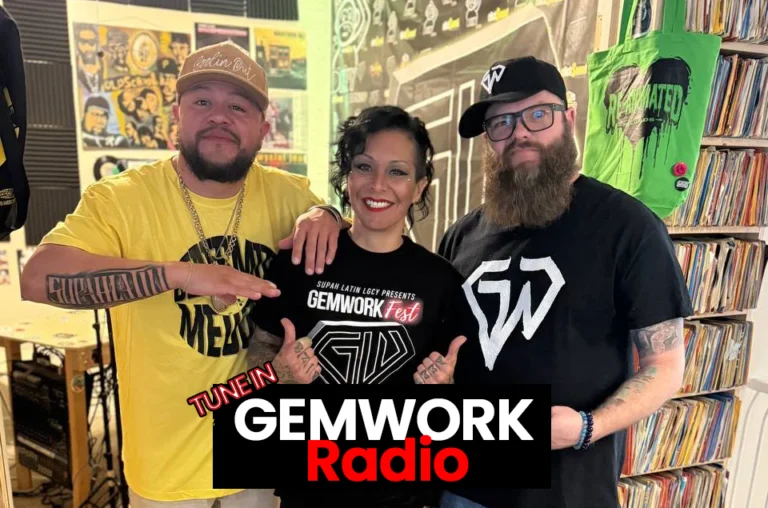
Live Radio · Thursdays 6–9pm MST
## Gemwork Radio
Gemwork Radio is DNKYBongsTV’s home for independent artists, underground music,
creative culture, and real conversations. We spotlight the people building outside
the mainstream, sharing their stories, their work, and the practical knowledge that
helps artists keep moving forward.
Raw. Real. Gemwork.
[Listen Live](https://dnkybongstv.com/gemwork-radio/) [Show Archive](https://gumm.digital/series-category/gemwork-radio-live/)
[Subscribe](https://gumm.digital/listen/)
Rights · Revenue · Release
## The Business of Independence
[Music Industry](https://gumm.digital/series-category/music-industry/)
GUMM STICKS
Small bite. Real value.
[All GUMM STICKS](https://gumm.digital/series-category/gumm-sticks/)
Every issue. Still alive.
[⌊The World Eclectic global music and culture show on DNKYBongsTV.⌉](https://gumm.digital/the-world-eclectic-2/)
Original Programming
## The World Eclectic
[Explore](https://gumm.digital/the-world-eclectic-2/)
The World Eclectic is DNKYBongsTV’s home for music, culture, and creative movement
from across the globe. We look beyond the obvious names and familiar playlists to
find the artists, scenes, sounds, and stories moving through Africa, the Caribbean,
Latin America, Asia, Europe, and the wider diaspora.
## Culture
[Features](https://gumm.digital/series-category/features/)
The G.U.M.M. Rack
## From the G.U.M.M. Archive
[All back issues](https://gumm.digital/issue/)
[⌊G.U.M.M. October 2026 cover: Blueprint Sankofa.⌉October 2026
### Blueprint Sankofa
[⌊G.U.M.M. September 2026 cover: How should an indie artist get paid now?⌉September
2026
### Get Paid Now?
G.U.M.M. · DNKYBongsTV Network
## Stay connected to the network
Built for the culture.
[Join Us](https://gumm.digital/membership-join/) [Subscribe to Podcast](https://gumm.digital/listen/)
[Submit Music](https://gumm.digital/submit-music/)
G.**U**.M.M.
Gemwork Urban Music Magazine
The Culture. The Music. The Movement.
Magazine
[Current Issue](https://gumm.digital/2026/09/30/blueprint-sankofa/)[Back Issues](https://gumm.digital/issue/)
[All Stories](https://gumm.digital/series-category/gemwork-urban-music-magazine/)
[GUMM STICKS](https://gumm.digital/series-category/gumm-sticks/)
Watch & Listen
[Gemwork Radio](https://dnkybongstv.com/gemwork-radio/)[The World Eclectic](https://gumm.digital/the-world-eclectic-2/)
[The Discussion](https://gumm.digital/the-discussion/)[Til The Tape Pops](https://gumm.digital/til-the-tape-pops/)
Music
[Last Kind Recordz](https://gumm.digital/last-kind-recordz/)[Grown RenegadeZ Music](https://gumm.digital/grown-renegadez-music/)
[LK Jazz](https://gumm.digital/lk-jazz/)[Sound Check](https://gumm.digital/sound-check/)
Artists
[Submit Music](https://gumm.digital/submit-music/)[DJ Access](https://gumm.digital/dj-access-2/)
[Sync Licensing](https://gumm.digital/sync-licensing-2/)[Join Us](https://gumm.digital/membership-join/)
[DNKYBongsTV Network](https://dnkybongstv.com/)Built for the culture. Powered by
NuCreative Media.
**G.U.M.M.**October 2026 · Interactive Issue
⌊G.U.M.M. October 2026 cover, Blueprint Sankofa: What we inherit. What we transform.
What we pass on. A collage built around a Sankofa bird with Cynthia Onstage, Sam
Jr., The Shop on 18th, Soul Goes to College, My Father’s Bass and The Next Voice,
plus seven more stories at right.⌉⌊G.U.M.M. October 2026 cover, Blueprint Sankofa:
What we inherit. What we transform. What we pass on. A collage built around a Sankofa
bird with Cynthia Onstage, Sam Jr., The Shop on 18th, Soul Goes to College, My Father’s
Bass and The Next Voice, plus seven more stories at right.⌉ [Sankofa ↘](https://gumm.digital/2026/09/30/blueprint-sankofa/)
[The Headshots in the House ↘](https://gumm.digital/2026/09/30/cynthia-onstage/)
[The Son With the Horn ↘](https://gumm.digital/2026/09/30/sam-jr/) [1906 / 18th Street ↘](https://gumm.digital/2026/09/30/the-shop-on-18th/)
[The Music Went With Him ↘](https://gumm.digital/2026/09/30/soul-goes-to-college/)
[Then There Was Me ↘](https://gumm.digital/2026/09/30/my-fathers-bass/) [In the Blood ↘](https://gumm.digital/2026/09/30/the-next-voice/)
[](https://gumm.digital/2026/09/30/copyright-costs-more/) [](https://gumm.digital/2026/09/30/video-matters-again/)
[](https://gumm.digital/2026/09/30/physical-isnt-dead/) [](https://gumm.digital/2026/09/30/ai-disclose-it/)
[](https://gumm.digital/2026/09/30/wheres-your-money/) [](https://gumm.digital/2026/09/30/one-song-many-checks/)
[](https://gumm.digital/2026/09/30/who-needs-a-press-release/)
Follow the Blueprint
[Sankofa](https://gumm.digital/#bp-sankofa)[1906 / 18th Street](https://gumm.digital/#bp-18th-street)
[The Son With the Horn](https://gumm.digital/#bp-the-horn)[The Music Went With Him](https://gumm.digital/#bp-the-music)
[The Headshots in the House](https://gumm.digital/#bp-headshots)[Then There Was Me](https://gumm.digital/#bp-then-me)
[In the Blood](https://gumm.digital/#bp-in-the-blood)
G.U.M.M. · October 2026Series **I** / II / III
Series One of Three
# Blueprint⏎ Sankofa
The Things We Go Back For
Go back and get it
## Sankofa
Sankofa · Read the symbol
The backward-looking bird in the cover carries the Akan idea of returning for what
is valuable. The stitched red, gold, green and black borders here are contemporary
textile-inspired design, not reproductions of historical cloth.
There is a bird that looks backward while moving forward.
Its feet point in one direction while its head turns toward what has been left behind.
In its beak, it carries something precious, often represented as an egg. This is
one of the visual representations of **Sankofa**, an Akan concept from Ghana commonly
understood through a deceptively simple instruction:
**Go back and get it.** Not _go backward_. Go **back**. There is a difference.
Sankofa asks us to consider the possibility that progress doesn't require abandoning
everything behind us. Knowledge can be recovered. Traditions can be reconsidered.
Work can be resumed. Something an earlier generation learned, built, protected—or
left unfinished—may still have value to the generation standing in front of it.
Throughout this story, Adinkra symbols and Ghanaian-inspired colors will appear
in the borders and artwork. They aren't here simply to make the page look African.
The symbols have meanings. The colors and patterns have histories. They are part
of the visual language of the story, because _Blueprint Sankofa_ isn't simply about
tracing a family tree.
It's about what people went back for.
A musician survives an accident and returns to the faith of his childhood, but takes
his music with him. His son carries that relationship between faith and music into
another generation. A young woman spends years balancing motherhood, work and the
career she still wants until the opportunity finally comes to pursue it fully. A
young rapper gets close enough to the record industry to see inside it, walks away,
raises a family, spends decades working regular jobs and eventually returns—not
only to his music, but to songs he left unfinished and a business infrastructure
he didn't understand the first time around. A little girl starts writing songs before
she's old enough to know that generations before her had been doing the same thing.
And now another little girl hears music and moves. To understand how we got there,
we have to do exactly what Sankofa asks. We have to go back.
Samuel M. Utterbach Sr.
## 1906 / 18th Street
Kansas City, Missouri · East 18th Street
**1708****1709**
**Barbershop**Across the street**Recreation center**
The recreation center is remembered in family history.
Imagine the year is 1906.
Theodore Roosevelt is president. The Civil War has been over for only forty-one
years. There are Americans still alive who remember slavery because they lived it.
For Black Americans, emancipation has not produced equality. Jim Crow is tightening
its grip across the country, enforced through law in some places and through custom,
intimidation and violence in others.
This is the America **Samuel M. Utterbach Sr.** has to navigate.
He comes out of Virginia and eventually makes his way to Missouri, part of the larger
movement of Black Americans searching for opportunities beyond what had been left
for them in the South. His story eventually reaches a particular block in Kansas
City: **1708 East 18th Street**.
Samuel operates a barbershop there. Across the street, at **1709**, family history
remembers his recreation center. Those addresses matter because this wasn't simply
somewhere Sam happened to rent a storefront. The streets surrounding him were becoming
part of the Black commercial and cultural machinery of Kansas City. The Black press
was nearby. Businesses were opening. Entertainment was growing. Musicians needed
places to work, meet, eat, get dressed, get paid and find the next job.
And Sam had a barber chair in the middle of it.
A good barber in those years needed considerably more than the electric clippers
we associate with a shop today. Scissors, straight razors, combs, brushes, tonics,
shaving preparations and hot towels were part of the trade. The work was intimate.
A customer sat down and, for the next little while, wasn't going anywhere.
That makes a barbershop something more than a place to get cleaned up. People talk.
Politics gets argued. News gets passed around. Somebody knows who's hiring. Somebody
knows who got fired. Somebody has heard which band is coming through town and where
they're playing afterward.
Every now and then, a white customer might have come through Sam's door too. Maybe
someone recommended him. Maybe his reputation traveled beyond the immediate neighborhood.
We don't know enough to manufacture the reason, and there's no need to. The contradiction
is interesting enough on its own: outside that door, America was investing enormous
energy into deciding where Black people belonged. Inside it, Samuel Utterbach was
building something of his own.
Then there was 1709—the recreation center. That part of the story still leaves questions.
Was there a pool table? Cards? Food? Music? A place simply to sit and socialize?
Those are possibilities, not facts, and family history doesn't become better by
turning the unknown parts into fiction.
But the geography remains intriguing. A barbershop on one side. A recreation center
on the other. Black businesses and the Black press nearby. Musicians moving through
the district while Kansas City was developing a sound that would eventually travel
around the world.
I can't give you the guest list for Sam's barber chair. I can't tell you which musicians
crossed his doorway. But I know who was growing up around it. His son. And young
Sam didn't become a barber. He picked up a trumpet.
Samuel M. Utterbach Jr.
## The Son With the Horn
Kansas City · Session notes
### George E. Lee’s⏎ Novelty Singing Orchestra
“Down Home Syncopated Blues”
“Meritt Stomp”
Sam Utterbach · Trumpet
**Samuel M. Utterbach Jr.** was born in 1899. By the time his father's businesses
were established on 18th Street, young Sam was growing up inside a Kansas City that
was beginning to sound different.
Music moved through theaters, dance halls, clubs and neighborhoods. Musicians came
into town looking for work and left carrying somebody else's riff in their heads.
Bands competed. Arrangers experimented. Players moved from one orchestra to another.
Kansas City wasn't simply listening to jazz. It was helping make it.
Sam became part of it.
He played trumpet. Family history also remembers him playing mellophone. By the
late 1920s, his name begins appearing in the surviving record of the Kansas City
jazz scene. In 1927, Sam Utterbach is documented on trumpet with **George E. Lee's
Novelty Singing Orchestra**, recording for Kansas City's Meritt label.
“Down Home Syncopated Blues.” “Meritt Stomp.” Put those records on today and something
remarkable happens: a man born in 1899 comes back out of the speakers. That's my
grandfather.
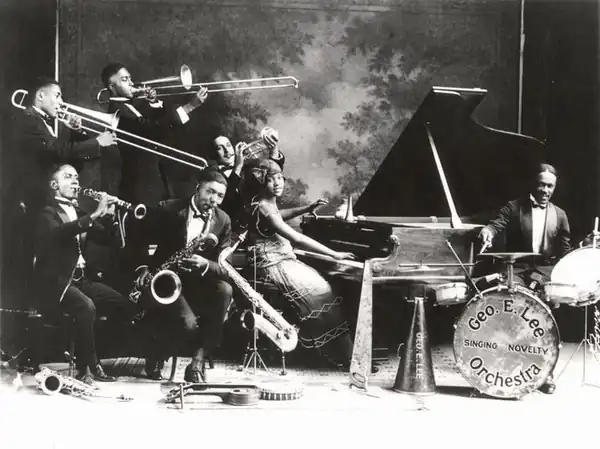
George E. Lee’s Singing Novelty Orchestra · Photograph from the family research
collection. Individual identities and the date are not assigned here.
Around him were musicians whose names became part of Kansas City jazz history—George
E. Lee, Thurston “Sox” Maupins, Clarence Taylor, Jesse Stone, Clint Weaver and others
moving through an orchestra whose personnel changed as opportunities did. By 1929,
Sam was still recording with Lee in an expanded orchestra that included another
trumpeter, Harold Knox, and musicians such as Herman Walder and a young **Budd Johnson**,
who would go on to a long career in jazz.
Sam wasn't watching that history happen. He was standing in it.
That's important to say plainly because families have a strange way of shrinking
their own history. A photograph becomes _Grandpa when he was young_. A record becomes
_that old thing somebody made_. A name printed on a session sheet gets put in a
box. Enough time passes and somebody finally asks the obvious question:
What was he actually doing? My grandfather was playing trumpet in professional Kansas
City orchestras while one of America's great musical languages was being formed
around him.
There are still holes. I've spent hours studying photographs of George E. Lee's
orchestras. Some come from before Sam's documented tenure; others fall around it.
Musicians changed. Captions disappeared. Men who once had names became “unidentified”
in archives. Family memory points toward one person, instrumentation sometimes points
somewhere else, and the dates complicate both.
Eventually, I realized I was in danger of allowing the missing photograph to become
more important than the man. I already have something more valuable than a face
to circle. I can hear him. The records survived. So did a story he told me about
why his relationship with music eventually changed.
According to the story my grandfather passed down, Sam was involved in a car accident
that killed a close friend and fellow musician. Sam survived. He had been raised
in a Christian home, and after the accident he went back to God.
That could have been the end of the music story. It wasn't.
Sam didn't decide that the trumpet belonged to the life he was leaving behind. He
brought it with him. If music had once belonged to dance halls, recording sessions
and the working life of a Kansas City musician, it could now belong to his faith.
He would be a musician for Christ. And somewhere nearby, his son Clinton was watching.
Clinton Utterbach
## The Music Went With Him
1967
Utterbach Concert Ensemble
### Soul Goes⏎ to College
Mary Dod Brown Chapel
Lincoln University
[Explore the Baylor archive ↗](https://digitalcollections-baylor.quartexcollections.com/Documents/Detail/soul-goes-to-college/2538084)
⌊Portrait of Pastor Clinton Utterbach, from the family archive.⌉⌊Portrait of Pastor
Clinton Utterbach, from the family archive.⌉⌊Pastor Clinton Utterbach holding a
microphone during a church service, from the family archive.⌉⌊Pastor Clinton Utterbach
holding a microphone during a church service, from the family archive.⌉
Pastor Clinton Utterbach — family archive.
**Clinton Utterbach** grew into a world where faith and music didn't have to be
reconciled. His father had already done the reconciling. Clinton chose gospel, and
by 1967 that choice had become large enough to have a name printed on a record: **
_Soul Goes to College_**.
The name on the recording was the **Utterbach Concert Ensemble**. It was recorded
at Mary Dod Brown Chapel at Lincoln University with an ensemble of more than thirty
voices. Among those singers were two young people whose names would eventually become
inseparable from my own story: **Cynthia Gudger and Joel Utterbach**.
My mother and father. Before Mom and Dad. Before me. They're voices together on
a record made under the Utterbach name, with Clinton standing at the center of that
connection. That's how inheritance actually moves. Rarely in a straight line.
Sam didn't hand Clinton a trumpet and tell him to continue exactly where he stopped.
Clinton took the principle and changed the form. The horn became voices. Jazz became
gospel. One musician became an ensemble.
Decades later, _Soul Goes to College_ would travel somewhere none of them could
have predicted. The recording became part of Baylor University's work preserving
Black gospel music. Something members of my family made when they were young survived
long enough to become evidence of a larger history.
There's a symmetry in that I can't resist. _Soul Goes to College_ eventually went
back to college. Only this time, it was there to be remembered. And one of the young
women singing on that record was nowhere near finished with music.
Cynthia Gudger
## The Headshots in the House
A life in music · Cynthia Gudger
The dream didn’t disappear.
It learned how to survive.
Work. Family. Music. And then the call came.

Cynthia Utterbach — family archive.
When I think about my mother's career now, I don't start with a stage. I start with
the walls.
There were photographs everywhere. Headshots. Actors. Singers. Dancers. Publicists.
People whose names and faces belonged to an entertainment world that seemed to be
constantly passing through our house even when my mother wasn't standing on a professional
stage herself.
Then there was her newsletter. She wrote. She circulated things. She stayed in touch
with people and maintained relationships. Looking backward, I realize something
I couldn't have understood as a kid: **Cynthia never really left the business.**
Life simply required her to conduct much of it from somewhere else.
She came from a family of singers and was the one who wanted to pursue it professionally.
But wanting something and being free to pursue it are not the same thing. There
was work. There were children. There were bills and responsibilities that don't
become less real because somebody has talent.
So she worked, and she sang.
Sometimes music happened after work. Sometimes it happened around work. She could
be the person doing the regular job and still find herself singing in the lounge
connected to the office building. The dream didn't disappear. It learned how to
survive.
Years passed. My brother grew up and left. I became old enough to take care of myself.
The responsibilities that had always answered _not yet_ began loosening their grip.
Then the call came. There was an opportunity overseas. This time Cynthia didn't
have to explain why she couldn't go. She could. So she went.
She wasn't a twenty-year-old running toward an untouched dream. She was a grown
woman who had already worked, raised children, postponed things, maintained relationships,
kept singing and kept enough of that other life alive that when the door finally
opened, she still knew how to walk through it.
Sometimes we talk about pursuing a dream as though the only proof of wanting it
badly enough is dropping everything else. My mother's story taught me something
different. Sometimes you take care of what needs taking care of, refuse to let the
other thing die while you're doing it, and when the moment finally arrives, you
go.
My Uncle Fred found another route. Even during his military years, music was there;
he DJed with reel-to-reel machines. His working life eventually took him into the
racing industry, but years later the road curved back toward contemporary jazz and
radio. He hosts a radio program in the South today. There is more to Fred's story,
and I want to hear that part from Fred before I tell it for him. For now, it's enough
to recognize the pattern: sometimes you come back through a different door.
B-Boy C → Mr. Baaka
## Then There Was Me
The route back
**B-Boy C** **NUTEE CROO** **KDAY** **IFresh** **Capitol** **The Last Kind****
Stray** **Sony** **Mr. Baaka** **KnowledgeCreative** **DNKYBongsTV**
My own route into music started long before The Last Kind, record labels or anything
resembling a business plan.
During my time with **KDAY Performing Arts**, I was in a crew called **NUTEE CROO**.
Back then I was **B-Boy C**, working alongside **LADIE BASS**, a beatboxer, singer
and rapper. We were young, making things, performing and finding our place inside
a Los Angeles culture where hip-hop wasn't something you studied from a distance.
You lived in the middle of it.
That also meant navigating everything surrounding the music. Gang politics and neighborhood
lines were real, while the conscious side of hip-hop was showing me another possibility
for what the culture could say. I gravitated toward records with something on their
minds, the kind of music that could hit hard without checking its intelligence at
the door.
Then we met **Ben Caldwell**.
I became involved with his film **_IFresh_**. The relationships around it led to
production opportunities and even a hair-care product deal involving **Donnie's
Hair Care Products**. One room kept opening into another, and eventually the music
attracted major-label attention.
We signed with **Capitol Records**.
For about a year, it looked as if the route forward might finally be visible. Then
it wasn't. Capitol dropped us, and afterward I largely stopped pursuing music as
a career.
I didn't stop writing. That's different. I kept writing songs, only most of them
went into the closet instead of the marketplace. Then **The Last Kind** pulled me
back out.
They put me on their album, and another project was supposed to follow. Before that
could happen, the business shifted again. Stray Records lost its Warner Bros. relationship
during a period when independent labels and dot-com-era companies were being cut
loose. I was able to help secure the group's release. We walked away with our dignity
and our music and eventually established our own label through a relationship with
Sony.
There was only one problem. I didn't really know how to run a record label.
That's easy to admit now. It wasn't necessarily easy to understand then. Having
access to the machinery isn't the same thing as knowing how to operate it. I could
write. I could make records. I understood artists. I'd already seen pieces of production,
product deals, major labels and independent labels. None of that automatically taught
me publishing, rights administration, metadata, licensing, accounting, distribution
strategy or how to build an organization that could survive when somebody else's
deal disappeared.
So the label existed, but for years I didn't fully understand what I had.
I had already traveled, performed in different countries and written a lot of songs.
One of the first songs I was able to get out featured **Bernadette Cooper of Klymaxx**.
But as the industry changed, the kind of conscious underground hip-hop I was making
increasingly moved away from the commercial center. The music didn't disappear,
and neither did the people making it. We went underground.
Life kept moving.
I raised children. I spent roughly twenty years in logistics and another decade
in customer-service leadership. I kept a home studio and kept writing, but family
and work had first claim on my time. Some of those songs have now been sitting with
me for fifteen years or more.
Then COVID stopped the normal rhythm of things.
I started podcasting. I started looking seriously at music again. This time I wasn't
returning as the same B-Boy C who had walked into KDAY Performing Arts, or even
the same Mr. Baaka who had maneuvered through underground hip-hop.
I came back carrying thirty years of other education.
Logistics had taught me systems. Putting something on a truck doesn't mean it reaches
the right destination. There is documentation, a chain of custody, handoffs and
information that has to travel with the package. Lose the information and eventually
something—or somebody—doesn't get what they're supposed to receive.
Music started looking remarkably similar.
A song moves through writers, producers, artists, publishers, labels, distributors,
rights organizations and streaming platforms. Metadata travels with it. Credits
travel with it. Money is supposed to find its way back through that chain.
Suddenly, twenty years in logistics didn't look like twenty years spent away from
music. It looked like training I hadn't realized I was receiving.
The customer-service years mattered too. I knew what it looked like when people
stood outside a system trying to get a straight answer about how it worked. Independent
artists do that every day. Hip-hop helped build an entire culture around doing things
ourselves, but doing it yourself shouldn't mean figuring out everything by yourself.
Sitting there in my own history was something I had never properly used: the continuing
Sony-related label infrastructure we had established years earlier. This time, I
had an idea for what to do with it.
I didn't want another label whose only purpose was putting out my own records. I
wanted to build something useful for underground hip-hop, independent artists and
cultural music, particularly music connected to the wider African diaspora.
That part was personal too. I grew up with **Beta Israel, Orthodox and Eritrean
cultural and religious influences** in my life. Africa and the diaspora weren't
abstractions I discovered when they became fashionable in music. They were already
part of how I understood culture, family and identity.
So the question stopped being, _How do I get myself back into the music business?_
It became: **What can I send back through the door?**
That question grew into labels, media, radio, artist platforms, DJ access and conversations
about the things I wish somebody had explained to me when I first started: ownership,
publishing, metadata, distribution, licensing and the business underneath the music.
Eventually, I found myself in a position the young B-Boy C couldn't have imagined.
I owned a media company. And somewhere along the way, I realized I had become one
of the people standing near a gate. So I decided to hold it open.
Now Sankofa has become unusually literal for me. I'm going through songs I wrote
fifteen years ago. Some should stay exactly where they are. Others deserve another
chance. I'm rewriting lyrics, reconsidering arrangements, rebuilding production
and finishing ideas with fifteen more years of life behind me.
I'm not trying to become B-Boy C again. I'm not trying to recreate the young Mr.
Baaka. I'm taking what those guys left me and deciding what the man I am now can
do with it.
The rapper comes with me. The producer comes. The traveler, father, logistics worker
and customer-service manager come. Mr. Baaka comes. KnowledgeCreative comes. The
label owner and media owner come too.
Going back doesn't erase the years between. You get to bring them with you. And
maybe that's the clearest expression of Sankofa in my own life. I'm not going back
because I want to live in the past. I'm going back because **I left some good music
there.**
What we pass on
## In the Blood
> “I couldn’t NOT
> be creating music.”
> Gabby · In the Blood
I asked my niece Gabby when she started making music. I expected a year, maybe an
artist who influenced her or a particular song that made her want to try it herself.
Instead, she basically told me there wasn't a beginning she could remember.
“OMG, I started when I was still in elementary school. I was writing songs from
as young as I can remember. It was honestly something that was just in my blood.
I couldn't NOT be creating music. It just happened.”
After spending all this time tracing musicians through my family, _it just happened_
hits differently.
Gabby didn't know Sam Utterbach standing in Kansas City with a trumpet. She wasn't
there when Clinton gathered voices into the Utterbach Concert Ensemble. She didn't
watch my mother finally take her music overseas, and she certainly wasn't sitting
beside me while I tried to figure out what to do with a record label I didn't know
how to run.
None of that had to be explained before she started writing. She was in elementary
school. She just wrote.
But inheritance doesn't mean repetition. What Gabby eventually found inside music
belongs to her own life. As she got older, songwriting became somewhere she could
put things that were harder to carry.
“I think over the years I used it as an escape,” she told me. “I've been through
some issues and definitely used the music to express it and get it out of my heart
and my head.”
That's where her branch becomes her own. Sam found faith and took his music with
him. My mother kept music alive through years when other responsibilities had to
come first. I went back and found old songs, old infrastructure and a different
purpose for the business surrounding them.
Gabby found a release valve. But she doesn't want the healing to stop with her.
She wants the person listening to participate in it. “I also want other people to
sing their hearts out to it,” she said. “My music is for healing.” Not streams.
Not followers. Not fame. Healing.
Maybe that's the part of inheritance we don't talk about enough. We tend to look
for the thing that stayed the same: his grandfather played music, his mother sang,
his niece writes songs.
The more interesting story is what changed. Every generation found a different use
for the same impulse. And now there's another generation in the room. My granddaughter
is only a year old. I'm not going to decide what she's supposed to become because
her family has spent more than a century making music. But I watch her.
When music comes on, she moves.
There are jazz instrumentals she responds to immediately—music her mother played
while she was carrying her. I can't tell you exactly what a one-year-old remembers
from before she was born, and I don't need to turn it into something mystical to
appreciate what I'm seeing. These are sounds that surrounded her at the very beginning
of her life, and when some of those sounds return, she responds.
For somebody who has spent this much time looking backward, it's impossible not
to wonder what I'm watching move forward.
I don't need her to become a singer. I don't need her to become a rapper, producer,
DJ or musician. I want to give her access to creativity before anybody gets a chance
to convince her that creativity belongs to somebody else.
Put instruments around her. Let her hear jazz, hip-hop, gospel and the sounds of
the diaspora. Give her books. Let her draw. Let her make noise. Tell her the stories.
Show her where the people before her came from and what they made with what they
had.
Then let her decide what any of it means. Sankofa doesn't require her to repeat
us.
Samuel Sr. built something on 18th Street. Sam Jr. picked up a trumpet and eventually
carried his music back into his faith. Clinton turned that inheritance toward gospel.
Cynthia held onto a professional dream long enough to step fully into it. Fred found
his way back through radio. I went underground, built another life and eventually
returned with enough experience to understand that the infrastructure around artists
mattered almost as much to me as making another record. Gabby started writing before
she was old enough to call any of that an inheritance.
And right now, the youngest one just dances. That's enough.
My responsibility isn't to tell her which part of the blueprint to follow. It's
to make sure she knows there is one—to surround her with enough history, culture,
music and possibility that when she discovers whatever is hers, she has the freedom
to make something new from everything that came before.
And if life ever makes her put something precious down, I hope she knows she can
go back for it.
**More Sankofa.**
Beyond the cover feature · 08–14
## Elsewhere in the⏎ October Issue
[08**Copyright Costs More**_What to register before fees rise._](https://gumm.digital/2026/09/30/copyright-costs-more/)
[09**Video Matters Again**_Original visuals are becoming valuable again._](https://gumm.digital/2026/09/30/video-matters-again/)
[10**Physical Isn’t Dead**_Streaming won discovery. Ownership still matters._](https://gumm.digital/2026/09/30/physical-isnt-dead/)
[11**AI: Disclose It**_Transparency rules are moving into music._](https://gumm.digital/2026/09/30/ai-disclose-it/)
[12**Where’s Your Money?**_Mechanical royalties may still be waiting._](https://gumm.digital/2026/09/30/wheres-your-money/)
[13**One Song. Many Checks.**_One release can open more than one revenue stream._](https://gumm.digital/2026/09/30/one-song-many-checks/)
[14**Who Needs a Press Release?**_The format still works, if you use it correctly._](https://gumm.digital/2026/09/30/who-needs-a-press-release/)
G.U.M.M. · Gemwork Urban Music Magazine
[Back to cover ↑](https://gumm.digital/#bp-cover)[Back issues](https://gumm.digital/issue/)
[All G.U.M.M. stories](https://gumm.digital/series-category/gemwork-urban-music-magazine/)
All 14 stories in this issue
## Every Story in⏎ the October Issue
[01**Blueprint Sankofa**_What we inherit. What we transform. What we pass on._](https://gumm.digital/2026/09/30/blueprint-sankofa/)
[02**The Shop on 18th**_Where opportunity began._](https://gumm.digital/2026/09/30/the-shop-on-18th/)
[03**Sam Jr.**_Where the music turned visible._](https://gumm.digital/2026/09/30/sam-jr/)
[04**Soul Goes to College**_Clinton carried it forward._](https://gumm.digital/2026/09/30/soul-goes-to-college/)
[05**Cynthia Onstage**_Discipline in plain sight._](https://gumm.digital/2026/09/30/cynthia-onstage/)
[06**My Father’s Bass**_Different tools. Same instinct._](https://gumm.digital/2026/09/30/my-fathers-bass/)
[07**The Next Voice**_She caught the bug anyway._](https://gumm.digital/2026/09/30/the-next-voice/)
[08**Copyright Costs More**_What to register before fees rise._](https://gumm.digital/2026/09/30/copyright-costs-more/)
[09**Video Matters Again**_Original visuals are becoming valuable again._](https://gumm.digital/2026/09/30/video-matters-again/)
[10**Physical Isn’t Dead**_Streaming won discovery. Ownership still matters._](https://gumm.digital/2026/09/30/physical-isnt-dead/)
[11**AI: Disclose It**_Transparency rules are moving into music._](https://gumm.digital/2026/09/30/ai-disclose-it/)
[12**Where’s Your Money?**_Mechanical royalties may still be waiting._](https://gumm.digital/2026/09/30/wheres-your-money/)
[13**One Song. Many Checks.**_One release can open more than one revenue stream._](https://gumm.digital/2026/09/30/one-song-many-checks/)
[14**Who Needs a Press Release?**_The format still works, if you use it correctly._](https://gumm.digital/2026/09/30/who-needs-a-press-release/)
G.U.M.M. · Gemwork Urban Music Magazine
[Back to cover ↑](https://gumm.digital/#bp-cover)[Back issues](https://gumm.digital/issue/)
[All G.U.M.M. stories](https://gumm.digital/series-category/gemwork-urban-music-magazine/)
Show Somebody: