
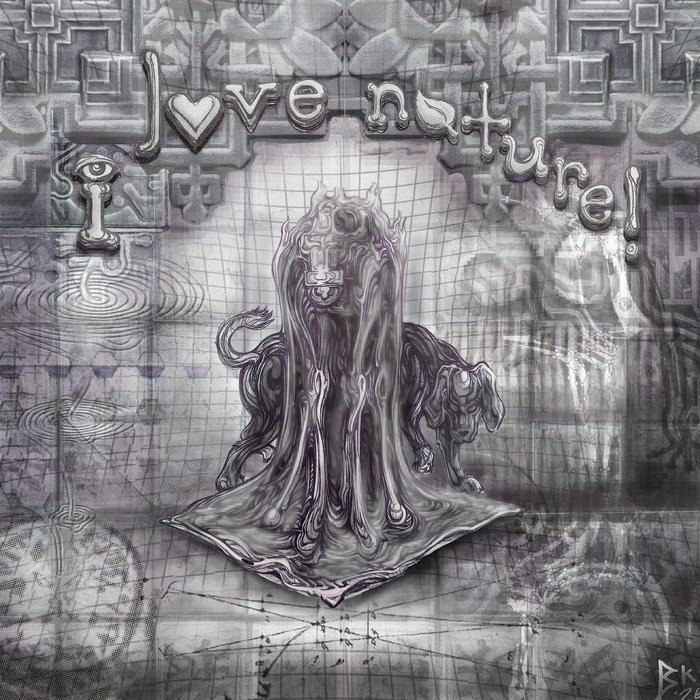
Big Flowers and shemar made an album called i love nature! that understands something obvious enough to be radical: the city is also an environment. Rent, sirens, exhaust, stress, friendship, grief, concrete and care all live inside the same weather system.
Nature did not stop at the city limits
The language around environmental music can get suspiciously clean. Forest. Ocean. Sunrise. Peace. Big Flowers and shemar are after something messier. Released September 25, i love nature! is a 12-track collaboration written primarily by Buffalo rapper/producer/visual artist Big Flowers and produced and mixed by shemar. The record’s titles alone behave like tiny mutations: “becoming tardigrade,” “the forest dies with its metronome,” “resist as macrophage,” “price of care,” “extinction pose.” Bandcamp Daily’s review framed the album around ecology, urban overload and a production style that can feel unstable by design. That instability is important. Environmental crisis is not only a scenic problem happening somewhere beyond the freeway. It is housing, labor, transit, health, heat, food, noise, policing, community and who has enough margin in their life to recover from any of it.
PULL QUOTE: The city is nature after rent, transit, stress and concrete enter the frame.
The beat is allowed to decompose
shemar’s production does not simply create a neutral floor for the rhymes. It bends, frays and reorganizes. Big Flowers’ writing moves through that landscape like somebody taking inventory while the shelves are shaking. This is useful in a hip-hop climate where “experimental” can become another branding adjective. Here, experimentation has a subject. The sonics are not strange merely to prove they can be strange. Their instability mirrors the album’s questions about systems, care and survival. The project is also firmly physical. Its Bandcamp page offers cassette and CD editions with full-color packaging and lyric materials; Brian Kwon is credited for the cover artwork. In an issue that keeps returning to memory, ownership and tangible culture, that matters. Physical media becomes part of the statement: the record exists somewhere other than a scrolling feed.
Care is a production technique
The album’s title is almost childlike, but the punctuation feels knowing: i love nature! There is wonder in it, but also urgency. That combination may be the most useful thing the record offers. Hip-hop does not need to become an environmental lecture to talk about climate. It has always documented environments with precision. Neighborhood reporting is environmental reporting when the neighborhood is treated as a living system rather than a backdrop for character development. Big Flowers and shemar simply turn the lens until the connections become impossible to ignore.
A Thanksgiving record for the sidewalk
This issue asks what giving back looks like. Here, it might begin with attention. Notice the environment you actually inhabit. Notice what is disappearing. Notice what the people around you are carrying. Notice who is doing the invisible maintenance that keeps a community functional. Then make something that refuses to look away.

 Los Angeles | Redlands | Phoenix | Memphis | NYC
Follow us: @GemworkTV | Contact: info@gemwork.tv
